Sunday, November 29, 2015

"that's the best thing a girl can be...

...in this world, a beautiful little fool" (Fitzgerald 17).  These famous words from the beautiful and delicate Daisy have been posted thousands of times on ignorant girls Instagram bios.  Amid it's caption with emoji flashes and glitter, it seems that this quote has lost it's meaning in todays world where feminism is a prevalent movement and such ideas are frowned upon.
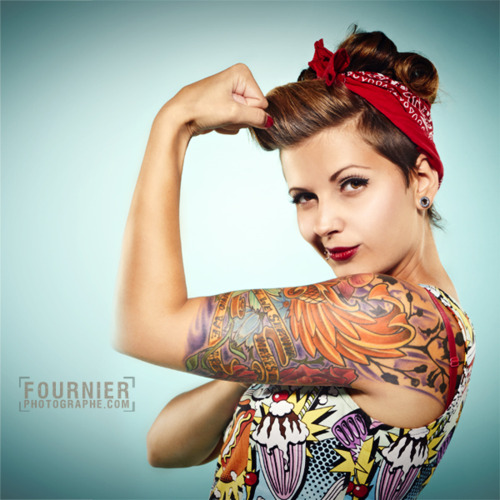
women are anything but innocent these days, from the looks of this picture
Back in the early nineteenth century, society valued women who were submissive and innocent: they were expected to remain home and take care of children and not have a mind of their own.  In a way, Daisy embodies this ideal by avoiding anything that displaces her from her more calm life.  She stays out of her husband's affairs while forgetting her real love for Gatsby.  She wants her daughter to be free of such "sinful" affairs by being innocent.  If a woman doesn't understand the truth and doesn't question her husbands motives and actions (such as where he gets his money), then she is better off being carefree.  This applies to the cliche "ignorance is bliss".  If you don't know what is going on in the rest of the world (poverty, war, refugees), you have less stress and can focus more on your own *petty* issues.  However, is this really better for society as a whole? How about for those around you? Educated people may not be able to live as non-chalantly, but they do get to understand things better without being put to the bottom and demoted as empty-headed.
innocence is bliss?
As the novel progresses, the innocence that women were supposed to have slowly slipped away to more sensual pleasures- such as Daisy's affair with Gatsby.  Like many of the women during the Jazz Age, the submissive character was stripped away as a sense of freedom came with the freedom to vote.  So maybe ignorance is not bliss after all, for such innocence can cause servitude.

Saturday, November 21, 2015

The dreadful day I got my ACT score...

Three weeks later, my ACT scores came out. When I got to my computer, the black screen seemed to be taunting me, asking me to unlock it. My mind was racing. "It's the test that decides your future, no big deal" it said.  I knew my parents would kill me, if they saw a bad score. They would disown me, put me "out in the wild somewhere" (Walls 280). Even more than that, no college would ever let me step onto their campus with a bad test score. I wanted to throw my computer out the door-- never let the scores get to me and ruin my life.

Instead, I logged into http://www.actstudent.org/. It was tan with a blue banner. I clicked on the scores button, and saw a blaring 36.

In the seconds that followed, I quickly scanned the subscores. 36, 36, 36 okay... 35.9 on reading?!? If this was a nightmare, I wanted it to end. If this was what failure feels like, I wanted it to end. If my parents wanted to disown me, they should just do it to end my pain. I couldn't believe this defeat was the result of 5,000 hours of studying, 60 practice tests, and innumerable amounts stress. I knew, that this moment would traumatize me for the rest of my life...


DISCLAIMERS:

1. this post was mimicking The Glass Castle page 280 (Walls, Jeannette. The Glass Castle. London: Virago, 2005. Print.)

2. this is also a sardonic post- not only did I never take the ACT and make up an impossible score, but it also shows that people put too much of their life on standardized testing (or even school and scores in general). As my fellow junior-suffering friends and I stress about getting the best scores possible, it seems like we all lose sight of what's important.  Yes, college is important, but the obsession should not consume your life and you should definitely not let a less than favorable score ruin your life.

Saturday, November 14, 2015

horror

ca·tas·tro·phe
kəˈtastrəfē/
noun
  1. an event causing great and often sudden damage or suffering; a disaster.


Many people will say they have not personally gone through a catastrophe. However, a catastrophe is not limited to events that affect a wide mass of people: it could be a local disaster, a family tragedy, or even a personal suffering. Nevertheless, widespread disasters affect all of us- it makes us realize just how lucky we are. Everyone comes into this world with a different circumstance. Things we can't control like our genetics, color of our skin, our physicality, etc. can greatly limit or stimulate us. In The Bluest Eye, Pecola Breedlove is restricted by her gender, skin color, nationality, and even her "ugliness". In fact, even her own race turns against her, one of whom made a distinction between "colored people [and] n******" (Morrison 124).

Supposedly, one is better than the other
Because of this, Pecola is constantly facing discrimination and, as a result, catastrophes. She is accused of killing a cat and even raped by her own father. Such events had me on the edge of my seat, filled with emotions that could only be described as horror. The only thing that kept me from breaking down was the fact that these events did not happen in real life. Unfortunately, however, these events do happen everyday, prevalently. While going through my daily internet surfing, I came about the rape accusations put upon a very well-known YouTuber: Sam Pepper. With over 2 million subscribers, he sexually assaulted and forever scarred over 8 girls. Girls that- like Pecola- are unable to come out (or even worse, are not believed when they do).
On the topic of catastrophes, the recent attack on Paris has left millions around the globe in shock and horror. Even worse, this event is happening around the globe, constantly.  Dozens of people killed in Beirut.  Hundreds of refugees dyeing in an attempt for a better life. Iraq.  Afganistan.  The list goes on. 

thousands of people have changed their facebook profile picture #prayforparis
It is important to remember that catastrophes are always happening, and each deserves mourning. You may not be the rape victim, the girl who had to pretend to be dead so she was not shot by the terrorists, or student diagnosed with cancer, but each event impacts you directly. Each event continues to remind us to value what we have and help whoever we can. On the same note, everyone does go through their own catastrophes, and even though it's not all over CNN or posters on the wall, these horrible events need to be treated with empathy. Cholly and Mrs. Breedlove's chapters taught me that much. 
"this is an attack on all of humanity and the universal values that we share" -B.O.

Saturday, November 7, 2015

YOU, yes you, are beautiful

What defines beauty? Or in other words, who is beautiful?  It may be overly optimistic to say that everyone is beautiful-that is impossible.  If everyone is beautiful, then no one is beautiful.  However, it does make sense to say that everyone is beautiful in their own way- in other words, beauty is in the eye of the beholder.

Shortly after The Martian, I was obsessing over this beautiful face- my good friend Emily, however, was not so ecstatic

I was moved to write this blog post after reading Toni Morrison's reaction to the first time she saw "beauty" as "the force of which was equaled by the knowledge that no one recognized it... not even the one who possessed it". A fellow female classmate can definitely relate with the following situation: you're in the bathroom with a friend and she can't stop picking out her flaws and declaiming  that she is "ugly". However, when we look at the mirror, we only see the impeccable characteristics that they seem to be oblivious to.  So maybe that's the reason for the fuzzy outline of beauty- no one believes they are beautiful.  Countless models we look up to daily in magazines body sham themselves (with the help of the press, of course).  So the problem doesn't seem to be that there is no set characteristics that a person should be to be considered beautiful- rather, they are unattainable.  No matter how skinny her waist is, or how flawless her hair looks, she still won't be perfect (at least to themselves). 
this does not apply to just females; males also get labeled for "hotness"
So is a L-shaped nose, blue eyes, and blonde hair the epitome of beauty? Or can a brown-skinned, curly-hair, and dusty brown eyes also be beautiful? The answer is yes; the problem is not everyone sees that.  Toni Morrison's book explores what society deems to be beautiful and how people (specifically one lost child) react to these standards. In a nutshell, everyone is beautiful- it just takes the right person to see it (ends with a trite statement).

Friday, October 30, 2015

Why the feminist movement has bumps

"Don't worry about your looks honey! It's what's on the inside that counts!" -every overly enthusiastic adult, ever.
In some sense, this is true- at least society wants it to be.  But in reality, looks are vital in daily life. After all, who hasn't looked at someone and judged them- whether it be taking notice of the mousy hair or the a less than desired layers of warmth around the stomach? It's a bit of a conundrum, really. We are told that it doesn't matter how someone looks but rather how someone acts.  But then why do we have the ability to see? We cannot see someone's "inside" or personality; but we can see their physical appearance.
do not tell me you haven't done this before
However, I am by no means trying to dismiss the utmost importance of personality over looks.  In its deepest level, this problem is due to flaws in human judgement and perception.  We only get to truly know a certain number of people in life; we only touch everyone else on the superficial level.  If that is the case, then how are we supposed to know someone's personality if we don't even know them?
so yes, it is the inside that counts
This issue is apparent in a recent article we read in class about Barbies (yes, the toy). While Prager (the author) does discuss the Barbie's "influence" in a very sardonic manner, she makes an important point about the feminist movement by putting it as "a time when women sought equality and small breasts were king". This is not entirely based off of the distorted proportion of Barbie but rather the basic truth in society:  tired of being oppressed and used for physical features, women sought to end the need for "big breasts" to be considered beautiful.  Although I absolutely agree with this train of thought, this is by no means a easy task on the most fundamental level.  Women are still being used today as "sex" objects and shown as obedient and submissive people in pop culture.  There is a long way for women to go before they can truly be free from social ties and expectations, considering how hard it is to consider people outside the influence of appearance.

Saturday, October 24, 2015

Time won't stop for your afternoon tea and reminiscing

Time can be seen as a very plastic element; traveling from one dimension to another has become accomplishable with the help of memory.

time is ruthless- it never stops even when we need a break

How many times have you thought about the past- whether it be a quick flashback or a full on musing? We use the past as both a vehicle for improvement and a deterrent from movement. We have all heard the saying "no need to cry over spilled milk"; however, sometimes, the events of the past continue to haunt us incessantly, and we must live in the past even when time moves on. This is exactly Vladek's case as a Holocaust survivor; despite trying to move on, his Holocaust stripes continue to clothe him until his grave.
may they rest in peace- peace from their memories, that is
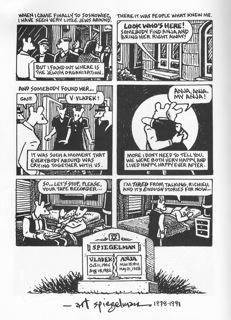
In the (non-HD) excerpt below, there is a striking contrast between the past and present- not only between Vladek's story and Art's point of view, but also with the gravestone. For one, the drawing of his and Anja's gravestone is without a border- showing that it is not confined with Art's story telling; their death is a physical quality with remains and no amount of story twisting is able to dispute that fact. Also, there is no page number on this page, showing that there is no time limit for their death- it is an externalized event. The seemingly ironic mention of Richieu in the last panel demonstrates how the past is continuously haunting Vladeck: he cannot stop thinking about his deceased son even when he is with Art, However, the smoke in the middle of his gravestone (which is strikingly similar to the smoke from the crematorium) shows that not only is his body gone, but his memories that haunted him before also leave him (although they are not gone forever for they are internalized by the story Art has wrote).


Saturday, October 17, 2015

Savoring the last drop of tea

Some things in life never leave us, even when they are long gone physically. Whether it be the best day of your life or the worst, memory is what keeps the past in the back of our minds. Holocaust survivors are unfortunately forever haunted by their inhumane treatment during WWII. In Maus by Art Speigelman, the father is now decades past his Holocaust experience yet he can never escape his memories.

behind bars

With a look at the statistics, the chance of survival was slim, with lack of better words. In certain countries such as Bulgaria, the survival rate was 0%- all fifty thousand people were killed in vain (Holocaust Timeline: Statistics of the Holocaust).  With this in mind, Vladek's ability to survive through the camp was a combination of luck, wit, and intelligence. However, some survivors may believe it would have been better not to survive the camp, as the memories will never leave them (shown in the suicide of Anja). Nevertheless, Vladek is able to continue living despite the inability to move on. It's a bit of a conundrum isn't it? Isn't living a sign of moving through life, through time? Yet Vladeck is shown-more than once- to be weighed down by his memories through his stationary bike and stripes (both panels are shown below).  His memories are like a circle- once they happened, they just kept on playing, never letting him out.  He will also never lose his stripes that decked him in his Holocaust uniform.


when searched on google, Holocaust is classified as a crime. But that seems to whitewash the reality and the after effects.


In a way, the title of this blog post is opposite of its content; although Vladeck will never forget his past (hence the last drop of tea part), it is nowhere near the positive connotation given through the idea of tea.
Disclaimer: sorry about the darker side of this post- some things just cannot be taken lightly.