Saturday, April 30, 2016

words

Language is like the river that travels through the city.  It gives life to the city, snaking through spots and bringing joy.  It can also ruin the city, when the tumultuous waves crash over the banks. Similarly, language can mend a problem or exacerbate it.  Recent developments in speech have seen the gradual elimination of "harmful" words that evoke ideas of "sexism, racism, and violence".   However, do these changes really change anything?  The truth is, while the words may be lying dormant, the issues still exist, regardless of whether they are spoken of or not.

filtering what we say
As Kakutani puts it, "Americans' [have] puritanical zeal for reform and [un]wavering faith in the talismanic power of words".  We act as if our words could change the world, when in reality, they are nothing less than empty words connected in sentences.  We believe that we can just sit back, change our sentences, and witness a change in society.  However, the true power in our words is, well, non-existant.  The "indirect speech" that characterizes much of our "ordinary politeness" also highlights the faults in our language-- the "fistula... [that] expos[es] us to an infectious world" (Pinker). When we open our mouths, we are releasing a stream of superficial letters that combine to form a cloud of "vagueness and innuendo" (Pinker).  This further exploits the fault in our language and the unreliability in using it as a model for social change.  In Cummins' illustration about bilingualism, he demonstrates the neccesity in a "smooth" language, rather than one that will not "ride" or translate the speaker places.  While this examines the barriers for culturally diverse students, it also shows the ultimate importance of a language that is not vague, chunky, or hidden.  Along the same lines, the unity of America can be accounted for by the "accident of our origins", or the fact that we are united under one common language (Krauthammer).  And if this language were to be stripped of its radical meanings, then so will the unity that comes with it.
when you mask words, you mask meanings and clarity
The importance of language cannot be contended with.  It is the glue that holds the nation together, that translate a thought to a communication factor, from that to a conversation.  However, we must realize that the power in words is not synonymous with a vehicle of change. If we eliminate radical words, we do not change the standing of such radical ideas in society.  Rather, we attempt to hide a problem that is, and always will be unless we take action outside of words, be present.

Sunday, April 17, 2016

freedom or safety

"We hold these truths to be self-evident, that all men are created equal, that they are endowed by their Creator with certain unalienable Rights, that among these are Life, Liberty and the pursuit of Happiness". The first sentence of the Declaration of Independence is one to be remembered.  These are the values that we, the US, hold to our dear hearts and use as our separation from the less democratic countries of the world.  However, the freedom outlined in these lines are not what many citizens want- instead, they want to be safe.

On a average day, an average man finds himself in many conundrums and at many crossroads.  It is only human instinct, however, to choose the road that leads to a safer life.  Often, that road is not one that guarantees the most freedom. For example, a typical internet user agrees to many policies that sacrifice his own freedom.  The terms and conditions to create an account on facebook include the condition that the user's name and other identifying information will be available to all those who see his profile.  While this seems like a horrid violation of the freedoms listed above, over 1.23 billion people have given up their freedom for such "safety". This safety is not the typical physical safety that often comes to mind, but rather "social safety". The idea that having a social media page will increase a person's value in society and therefore their safety in modern technology.


H. L. Mencken once said, “The average man does not want to be free. He simply wants to be safe.” In modern society, the idea of being safe socially may have been kept, but in the process, freedom has been sacrificed. 

Thursday, March 24, 2016

Asian Education

"I hate how asians have to be perfect to get into a decent college"
-a somewhat abbreviated version of a paragraph rant by an anonymous submitter
The popular Troy High Confessions page on Facebook has been under fire lately with idea of "actually living" during your high school life and "trying hard now so you can be happy later in life". This goes back to the whole idea of education and what you are really learning. In Indian Education by Sherman Alexie, he not only chronologically shows his education, but he is also shows the things he learns from society. He learns that discrimination is a real threat, that you have to try and put in effort to release yourself from the constraints of stereotypes, and that it is possible to move forward in life. 
taking initiative to be different
Unfortunately, many students nowadays find this idea hard to believe.  Just by looking at the results of the anonymous survey today, it is apparent that many, many people still do not feel comfortable in their ethnicity. Minority races do not feel equal to caucasians, through their treatment and their expectations. Going back to the quote from the confessions page, it is noteworthy that Asians have such high expectations and reap little in return. If two people of different races put in the same effort, same time, and same energy into a task and generate the same results, should one person really be rewarded more for the same efforts? 
the same, but different
America prides itself in giving everyone equal opportunities and being a "free country", but are we truly free when over 150 million people feel underrewarded for their efforts? The idea of equality can be genuine on the text of the Constitution, but when words are put into actions, things don't always translate smoothly. 

Sunday, March 20, 2016

here's some tea for your refreshment...

We are in the midst of a political turmoil.  With the results of the primaries coming out soon, and little to be desired in the candidates, with the dire situation of the Flint water, with the newest relations with our biggest rival, with the new appointed Supreme Court Justice, America is undergoing vast changes. On the outside, our democracy seems the same equitable system as always-however, there's so many problems that if it were not for our stable system, would have destroyed our country already.

Source: politicalcartoons.com; Artist: Dave Granlund
Nothing is more appropriate for this blog post than a cartoon about the Flint situation, right? A event that has gained a national attention and aid from many helpful communities that could have easily been prevented if not for a sneaky cover-up by the governor-- now that's a good topic! In the midst of all the hate against the government and pity for the Flint residents, Granlund is able to satirize the guiltiness of Governor Snyder himself. The setting of the cartoon is before congress, bringing the whole idea a sense of ethos.  The conveniently yellow water besides is a sign of hospitality- or is it? His question frames his guiltiness: he knows that if the water is truly from Flint, he cannot drink it for it is poisonous.  Yet if he will not drink the water himself (highlighted by the sweat from his collar) then why would he let his own citizens drink it? The painful irony fully exploits the faults in the governor's actions and the preventability of the crisis.

Monday, March 14, 2016

Going too far?

There has always been a fine line between knowledge and innocence- or is there?
This week's discussion of the limitations and expansion of science reminded me of our frequent discussion of knowledge and innocence in past English classes- is knowledge power or is ignorance bliss?
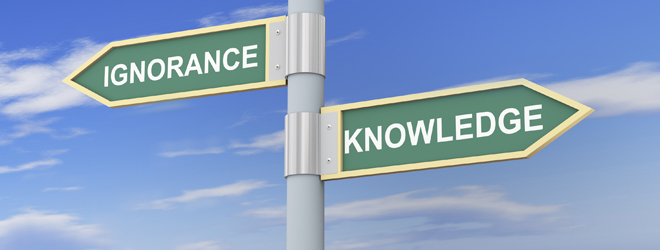
the opposite lanes 
The obvious truth is you cannot have both- you cannot be educated yet be not be educated.  If that is the case, then where is the line drawn? The endless possibilities of science and technology stretch from finding the cure to cancer in "the spontaneously radiant radium" to replacing genes in "tobacco plants with... purloined genes". These include the "best and worst of our quest for knowledge".  The idea of choosing innocence over knowledge in the Measure of Restraint highlights the moral implications of going too far in science.  It may be okay to examine the leaves of tobacco plants, but the idea of "forever altering" the genetics of these plants has long lasting effects that extend beyond a single science experiment. If we keep on looking for the cure to cancer, will we eventually come to a spot where we must decide between risking lives to find the cure or staying on our path of ignorance? This decision might've already been put to test with the Curies' found radium.  When "properly used [it is] an effective treatment for cancer", but when it's used "craz[idly]", it "takes it's toll".
A eternal change.
So I am back to my original question that, from the humble origins in 6th grade english, still has not been answered.  Raymo brings up the true perils of going too far in the quest for knowledge, but the multitude of dying cancer patients show the true perils of not going too far.

Saturday, March 5, 2016

Gandhi, Janet, and a short PSA

PSA: Reading Videotape at 2AM is not recommended.

So if you thought that Videotape was going to be a light read like me, and decided to venture upon it at night, you would have found it is no haiku.  Hereafter today, I believe everyone will stop procrastinating when they read.  The rhetoric throughout the piece is extremely shocking, as it uses a innocent child to convey its idea. The child "videotaping" the entire scene adds a sense of innocence to the piece; the fragmented sentences later in the piece reflect the fragmenting nature of the encounter for everyone involved, but especially the child. Throughout the piece, DeLillo rarely gives any of the characters names, leaving their identities to be very vague, showing that this incident could happen to every, even you. Some say giving the wife a name- Janet- is like the rest of the characters are hot for humility, but I disagree.  I think adding a name for her adds to the verisimilitude throughout the piece- it also shows how you tend to show family tragedies to highlight the idea of the "shortness of life". This idea of family goes along with Gandhi's idea of peacefully protesting- after all, you wouldn't want to lose family over violence that could be avoided peace, now would you?

I didn't want a picture of a murderer at 2am, so here's an accurate depiction of me trying to write a puzzle paragraph
I will admit that some of the words from the puzzle paragraph were quite awkward and forced. However, it was interesting to have several words to incorporate since it gave me a path to write my blog (rather than have me stare a blank screen for 2 hours).

Sunday, February 28, 2016

The Olive

Tired Student Fustrated in Self for Already Sleeping

POUGHKEEPSIE, NY--  Pressured to stop the coffee machine and proceed to her bed at 1AM in the morning, tired student Nathan Greene was said to be extremely frustrated in himself for already going to bed. "Usually I have to drink at least three cups of coffee and two cans of Red Bull, and stay up until 4AM, but this... this is embarrassing", said a gloomy Greene, who eventually finished brushing his teeth in disbelief. "It's hard to comprehend, but I'm actually tired.  God, I'm better than this. I can't be going to sleep when all my friends are still up watching Netflix.  Where's the swaggness in that?" A disoriented Greene was later seen getting up in the middle of the night to take a snapchat of himself studying to send to his friends.

Student Working Out at Gym as if it were Prom Tomorrow 

GEORGIA-- Tightly clutching her newly bought gym clothes and shoes, Cassidy Gerald breathed heavily as she finished her last set in the gym, confirmed sources last Thursday. "I need to look thinner by tomorrow-- I promise" whispered Gerald, as she jumped 5 millimeters above ground to make sure she could see her newly formed muscles bulging in the side mirror and silver flash of the Nike sign on her sports bra. "Don't worry, these flabs will be abs in no time". At press time, Gerald was petrified to realize she had been looking at someone else's body the whole time.


Sunday, February 21, 2016

Hi, I'm a pollo-pescetarian

That's right, a pollo-pescetarian.  Basically, I only eat poultry and seafood (with the exception of the times when my parents force me to eat the steak they prepared for dinner).  This is by no means a very hard or restrictive task- red meat was always too heavy for me and seafood is probably the best thing ever.  That being said, reading "Consider the Lobster" by David Foster Wallace was quite a harsh journey.  Lobster is probably my favorite seafood, and reading reasons why such preparation is unethical was definitely not a helpful boost.
can we just...
I have several issues with the argument that cooking a lobster is just plain out cruel.  First of all, the idea that you're killing a lobster in front of your eyes is not a new one.  In fact, if you go to China, it is not uncommon for freshly slaughtered chickens to be hanging by their neck, awaiting their next customer.  If preparing a lobster yourself is cruel, then what about chickens? Turkey? How about that well done steak you had for lunch yesterday?  In the end, that nice dinner is really a dead animal, and if you have problems with that, then you should probably be a vegetarian.  While this all sounds quite harsh, it is only the reality.  And whether you are fine with the idea of killing another living mammal for your eating pleasure or not, that is a personal decision that should not inflict on others.  There should not-- and is not-- a universal decision on vegetarianism.  In fact, you can see from my own classification that there are many parts to such a decision.
maybe a more pleasant picture for some of you
I know I make quite a few controversial points here that can be easily disputed.  As a disclaimer, I am not bashing Wallace's points/essay in any way.  In fact, my argument here only strengthens his, as he states that discussion of this conundrum "should stop... right here"(680).  Everyone has there own varying degrees of moral codes, but for now, I'm going to stick with my lobster dinner.

Monday, February 15, 2016

Asian girls and public space

Like many of my fellow asian female friends, I am a bit under the average female height, a little smaller on the eyes, and a minuscule bit darker on the hair.  It's not hard to spot me in the crowd- actually, just kidding, it's hard to see my head under the crowd of heads above mine.  It's not uncommon for a whisper to ask if I am in the wrong school- "does she know this is high school?" "why is her hair so straight? I bet she wakes up early to straighten it every day" "she is obviously sleeping while she is walking- you can't even see her eyes!". 

I clearly remember my first encounter with being a responsible-aged girl stuck in a small body.  As I was biking with  my younger brother around my subdivision, a concerned, elderly woman approached me and asked if I was lost.  It came as a shock to me that she did not ask my brother (who by the way, is 5 years younger than me) but rather approached me.  Maybe it was because my new bike had a bit of a disproportion to my body, or that my bright pink helmet just screamed trouble, but regardless, I was the weak one.  This incident repeated itself many times, whether it was me driving the car or when I went shopping alone.  My uncanny appearance always rose a couple stares and usually resulted in a concerned inquiry about my age. 
As for now, I will try to make my appearances a bit more inconspicuous- maybe I should look into height enhancers or change my hair color.  Maybe I should cut my hair short and start wearing male clothing.  Maybe then I wouldn't have the power to "alter public space" (Staples). 

Saturday, February 6, 2016

Dear Dad...

I can't remember the last time we had a conversation.  Maybe it was about college, maybe about getting my license.  Honestly, such exchanges have long become extinct.  I had some time to reflect this week on our relationship through thought-provoking discussions in english, and I think I know where it all went wrong.  Well, not wrong.  Just lost our connection, our relationship.

We've always had a precarious relationship based off goals and expectations.  I remember you canceled my birthday dinner when I was 8 because I didn't win my piano competition.  Or that time you made me quit art classes because I wasn't sleeping 10 hours every night.  Or how about that time when switched my violin teacher without me knowing because I was sitting "too far back".  I know you always had the best intentions for me, but your way of communicating your love never made it out of my fickle childhood.  I supposed I need to take part of the blame as well. I was always the slow child that all asian parents hate-- took their time with everything and had "rests" that were longer than the "working" time.   With little communication and a whole lot of unattainable goals, we slowly drifted apart as I "[grew] faster mentally" and became "more myself" (Manning 145).  I was able to separate who I really was from your dreams for me.

I hope one day we will be able to rekindle our relationship and see each other without the barriers of expectations and reality.  Maybe we will talk about college again.  Maybe you'll look into some "good" majors to go into and give me choices I must choose from.  Or maybe, "rather than any of this", we can sit down and have a open-hearted conversation (Manning 148).

-- your daughter

Sunday, January 31, 2016

being a minority

"... some disabled people call you TAPs, or Temporarily Abled Persons" (Mairs 15).  This chilling line stuck with me long after finishing the reading-  we are, after all, prone to an accident any moment of our lives.  Yet with that truth in mind, why are disabilities so hard to accept?  They are still seen as the unfortunate, the people to be careful around.  As the Mair mentioned, her disability "doesn't devour [her] wholly".  Just like the rare eye color green, such abnormalities should not become the essence of a person.

disability is only a characteristic, not a person

We talk a lot about minorities in this class, from African Americans to those with disabilities to females.  As an asian, I can whole-heartedly agree with many of these people's claims of disadvantages. One of the problems with Troy High is that many people do not understand what it feels like to be an minority- especially asians.  Students are eventually stratified with their own nationality as classes become more varied, and it's often rare to see different cultures mixing.  Just take a look at the tables during lunch: groupings are almost strictly by race.  However, in reality, only 5.6% of the population is Asian; that is for sure a minority. Yet according to the 2010 census, nearly 1 in 5 people have a disability.  Then why is the idea of being disabled seems so far away and unreachable?
alumni of Troy High, and experiencing the limitations of being asian in the adult world
Throughout this post I have made it sound like a disability is as limiting as being asian; however, in reality, a disability can truly consume one's life and activities, preventing them from doing daily acts. Nonetheless, is not how the disability affects the person, but rather how the TAPs view them.  Minorities will continue to be unproportional in numbers to their more prevalent peers, but the characteristics that stymie them should not control their potential.

Saturday, December 12, 2015

Frozen Dreams

As early action decisions start rolling out this month, many seniors will be either devastated or ecstatic.  It seems like this piece of paper, this letter of admissions, is the pivotal point in their lives. In other words, it's their Judy Jones.  This moment in their life is probably the most important up to this point, as they are constantly "unconsciously dictated by [their] winter dreams" (Fitzgerald 2).


Dexter starts out as the epitome of a self made man, one that rises from modesty to recognition and wealth.  However, Judy Jones comes in and- in part- ruins much of what he has worked for.  In other words, Judy comes to represent the materialism that was the demise for many of the wealthy during the Jazz Age.  Ultimately, Judy becomes "old news" and all the sacrifice Dexter made for her went to nothing.  The irony of the situation seems to parallel modern society with the rigorous college admissions process.  Many parents start preparing their children to become respected and educated students from a young age.  However, these efforts often go in vain as we as students tend to forget what we are really working for.  Judy/college comes into our lives, becoming our winter dream.  Yet contradictorily, these dreams freeze our conscious, rendering us from moving forward.  In the end, all dreams, all hope, cannot be focused on one goal or one object.  Because when that thing is gone, so is all the hope.  
don't let anything block your vision
Fitzgerald's warning against materialism and the demise of the once potent American Dream can even be seen today.  Similar to the way racism is still present (and how Lorraine Hansberry included the continuation of the problem in Raisin in the Sun), the problem of frozen dreams and blurred vision continues to deter talented students from the real goal. 

Sunday, December 6, 2015

destroyed and alone

The entire ending of this book was just a emotional storm-- actually, the entire book was.  I was constantly torn between straight up fangirling and obsessing over the rich and sophisticated Gatsby (Leanardo DiCaprio!!!) and yelling at him to stop obsessing over the past. The fact that Gatsby held these wild parties with great attendance and ceaseless attention over his mysterious figure by its guests seems to contradict his bland funeral.  Why is it that someone who was so popular when he was alive just a ghost once his spirit is gone?

he was alone in the end.
Ironically, the only person who came to his funeral other than the ever so constant Nick is the father who James Gatz left as a young man.  As a man who was never influenced by the materialism wealth (he stayed in the West all of his life), Gatsby's father does not have the fickleness that the residents of the East do: he values people with moral values without regarding them as mere temporary items.  It seems that the people we encounter in this book are only worried about the material wealth tied with events and items- if it is no longer relevant, it is not worth their time and resources to consider.  Even Daisy, the one person Gatsby focused over half a decade of his life on, sent no condolences or even recognition of the tragedy. Yet Mr. Gatz remembers his son and even reminisces over the determination Gatsby had as a young boy to improve himself and his social status.  This goes back to the importance of speed during this time period.  Time seems to move at an infinte speed for the residents of East Egg- the past is only a distant memory.  However, it seems that this "speed" never reached Gatsby.  He is and always will be a man living in the past.  At the same time, it is important to note how much his obsession over the dream of Daisy has consumed Gatsby. It seems as though Gatsby had a fresh and morally right future in front of him- he was a bright boy with ambitions and the right of mind (as noted by his father).  Yet Nick knows who he has become. He knows that through the process of trying to gain material wealth and consequently Daisy, Gatsby succumbed to the ruins and corruption that characterized so much of this time period.  
corruption consumed him.
The demise of Gatsby seems to highlight the moral fraud many of those during the infamous "Jazz Age".  The moral values Nick tried to find so desperately in the opulent Eggs was nonexistent: those caught up in this lifestyle could not see past the lavish parties and the swiftness of life. Real relationships never truly happened.  All the relationships in this book were characterized with insincerity, hopelessness, and artificiality.  This age destroyed even the most pristine of characters. 


Sunday, November 29, 2015

"that's the best thing a girl can be...

...in this world, a beautiful little fool" (Fitzgerald 17).  These famous words from the beautiful and delicate Daisy have been posted thousands of times on ignorant girls Instagram bios.  Amid it's caption with emoji flashes and glitter, it seems that this quote has lost it's meaning in todays world where feminism is a prevalent movement and such ideas are frowned upon.
women are anything but innocent these days, from the looks of this picture
Back in the early nineteenth century, society valued women who were submissive and innocent: they were expected to remain home and take care of children and not have a mind of their own.  In a way, Daisy embodies this ideal by avoiding anything that displaces her from her more calm life.  She stays out of her husband's affairs while forgetting her real love for Gatsby.  She wants her daughter to be free of such "sinful" affairs by being innocent.  If a woman doesn't understand the truth and doesn't question her husbands motives and actions (such as where he gets his money), then she is better off being carefree.  This applies to the cliche "ignorance is bliss".  If you don't know what is going on in the rest of the world (poverty, war, refugees), you have less stress and can focus more on your own *petty* issues.  However, is this really better for society as a whole? How about for those around you? Educated people may not be able to live as non-chalantly, but they do get to understand things better without being put to the bottom and demoted as empty-headed.
innocence is bliss?
As the novel progresses, the innocence that women were supposed to have slowly slipped away to more sensual pleasures- such as Daisy's affair with Gatsby.  Like many of the women during the Jazz Age, the submissive character was stripped away as a sense of freedom came with the freedom to vote.  So maybe ignorance is not bliss after all, for such innocence can cause servitude.

Saturday, November 21, 2015

The dreadful day I got my ACT score...

Three weeks later, my ACT scores came out. When I got to my computer, the black screen seemed to be taunting me, asking me to unlock it. My mind was racing. "It's the test that decides your future, no big deal" it said.  I knew my parents would kill me, if they saw a bad score. They would disown me, put me "out in the wild somewhere" (Walls 280). Even more than that, no college would ever let me step onto their campus with a bad test score. I wanted to throw my computer out the door-- never let the scores get to me and ruin my life.
Instead, I logged into http://www.actstudent.org/. It was tan with a blue banner. I clicked on the scores button, and saw a blaring 36.

In the seconds that followed, I quickly scanned the subscores. 36, 36, 36 okay... 35.9 on reading?!? If this was a nightmare, I wanted it to end. If this was what failure feels like, I wanted it to end. If my parents wanted to disown me, they should just do it to end my pain. I couldn't believe this defeat was the result of 5,000 hours of studying, 60 practice tests, and innumerable amounts stress. I knew, that this moment would traumatize me for the rest of my life...


DISCLAIMERS:

1. this post was mimicking The Glass Castle page 280 (Walls, Jeannette. The Glass Castle. London: Virago, 2005. Print.)

2. this is also a sardonic post- not only did I never take the ACT and make up an impossible score, but it also shows that people put too much of their life on standardized testing (or even school and scores in general). As my fellow junior-suffering friends and I stress about getting the best scores possible, it seems like we all lose sight of what's important.  Yes, college is important, but the obsession should not consume your life and you should definitely not let a less than favorable score ruin your life.

Saturday, November 14, 2015

horror

ca·tas·tro·phe
kəˈtastrəfē/
noun
  1. an event causing great and often sudden damage or suffering; a disaster.


Many people will say they have not personally gone through a catastrophe. However, a catastrophe is not limited to events that affect a wide mass of people: it could be a local disaster, a family tragedy, or even a personal suffering. Nevertheless, widespread disasters affect all of us- it makes us realize just how lucky we are. Everyone comes into this world with a different circumstance. Things we can't control like our genetics, color of our skin, our physicality, etc. can greatly limit or stimulate us. In The Bluest Eye, Pecola Breedlove is restricted by her gender, skin color, nationality, and even her "ugliness". In fact, even her own race turns against her, one of whom made a distinction between "colored people [and] n******" (Morrison 124).

Supposedly, one is better than the other
Because of this, Pecola is constantly facing discrimination and, as a result, catastrophes. She is accused of killing a cat and even raped by her own father. Such events had me on the edge of my seat, filled with emotions that could only be described as horror. The only thing that kept me from breaking down was the fact that these events did not happen in real life. Unfortunately, however, these events do happen everyday, prevalently. While going through my daily internet surfing, I came about the rape accusations put upon a very well-known YouTuber: Sam Pepper. With over 2 million subscribers, he sexually assaulted and forever scarred over 8 girls. Girls that- like Pecola- are unable to come out (or even worse, are not believed when they do).
On the topic of catastrophes, the recent attack on Paris has left millions around the globe in shock and horror. Even worse, this event is happening around the globe, constantly.  Dozens of people killed in Beirut.  Hundreds of refugees dyeing in an attempt for a better life. Iraq.  Afganistan.  The list goes on. 

thousands of people have changed their facebook profile picture #prayforparis
It is important to remember that catastrophes are always happening, and each deserves mourning. You may not be the rape victim, the girl who had to pretend to be dead so she was not shot by the terrorists, or student diagnosed with cancer, but each event impacts you directly. Each event continues to remind us to value what we have and help whoever we can. On the same note, everyone does go through their own catastrophes, and even though it's not all over CNN or posters on the wall, these horrible events need to be treated with empathy. Cholly and Mrs. Breedlove's chapters taught me that much. 
"this is an attack on all of humanity and the universal values that we share" -B.O.

Saturday, November 7, 2015

YOU, yes you, are beautiful

What defines beauty? Or in other words, who is beautiful?  It may be overly optimistic to say that everyone is beautiful-that is impossible.  If everyone is beautiful, then no one is beautiful.  However, it does make sense to say that everyone is beautiful in their own way- in other words, beauty is in the eye of the beholder.

Shortly after The Martian, I was obsessing over this beautiful face- my good friend Emily, however, was not so ecstatic

I was moved to write this blog post after reading Toni Morrison's reaction to the first time she saw "beauty" as "the force of which was equaled by the knowledge that no one recognized it... not even the one who possessed it". A fellow female classmate can definitely relate with the following situation: you're in the bathroom with a friend and she can't stop picking out her flaws and declaiming  that she is "ugly". However, when we look at the mirror, we only see the impeccable characteristics that they seem to be oblivious to.  So maybe that's the reason for the fuzzy outline of beauty- no one believes they are beautiful.  Countless models we look up to daily in magazines body sham themselves (with the help of the press, of course).  So the problem doesn't seem to be that there is no set characteristics that a person should be to be considered beautiful- rather, they are unattainable.  No matter how skinny her waist is, or how flawless her hair looks, she still won't be perfect (at least to themselves). 
this does not apply to just females; males also get labeled for "hotness"
So is a L-shaped nose, blue eyes, and blonde hair the epitome of beauty? Or can a brown-skinned, curly-hair, and dusty brown eyes also be beautiful? The answer is yes; the problem is not everyone sees that.  Toni Morrison's book explores what society deems to be beautiful and how people (specifically one lost child) react to these standards. In a nutshell, everyone is beautiful- it just takes the right person to see it (ends with a trite statement).

Friday, October 30, 2015

Why the feminist movement has bumps

"Don't worry about your looks honey! It's what's on the inside that counts!" -every overly enthusiastic adult, ever.
In some sense, this is true- at least society wants it to be.  But in reality, looks are vital in daily life. After all, who hasn't looked at someone and judged them- whether it be taking notice of the mousy hair or the a less than desired layers of warmth around the stomach? It's a bit of a conundrum, really. We are told that it doesn't matter how someone looks but rather how someone acts.  But then why do we have the ability to see? We cannot see someone's "inside" or personality; but we can see their physical appearance.
do not tell me you haven't done this before
However, I am by no means trying to dismiss the utmost importance of personality over looks.  In its deepest level, this problem is due to flaws in human judgement and perception.  We only get to truly know a certain number of people in life; we only touch everyone else on the superficial level.  If that is the case, then how are we supposed to know someone's personality if we don't even know them?
so yes, it is the inside that counts
This issue is apparent in a recent article we read in class about Barbies (yes, the toy). While Prager (the author) does discuss the Barbie's "influence" in a very sardonic manner, she makes an important point about the feminist movement by putting it as "a time when women sought equality and small breasts were king". This is not entirely based off of the distorted proportion of Barbie but rather the basic truth in society:  tired of being oppressed and used for physical features, women sought to end the need for "big breasts" to be considered beautiful.  Although I absolutely agree with this train of thought, this is by no means a easy task on the most fundamental level.  Women are still being used today as "sex" objects and shown as obedient and submissive people in pop culture.  There is a long way for women to go before they can truly be free from social ties and expectations, considering how hard it is to consider people outside the influence of appearance.

Saturday, October 24, 2015

Time won't stop for your afternoon tea and reminiscing

Time can be seen as a very plastic element; traveling from one dimension to another has become accomplishable with the help of memory.

time is ruthless- it never stops even when we need a break

How many times have you thought about the past- whether it be a quick flashback or a full on musing? We use the past as both a vehicle for improvement and a deterrent from movement. We have all heard the saying "no need to cry over spilled milk"; however, sometimes, the events of the past continue to haunt us incessantly, and we must live in the past even when time moves on. This is exactly Vladek's case as a Holocaust survivor; despite trying to move on, his Holocaust stripes continue to clothe him until his grave.
may they rest in peace- peace from their memories, that is
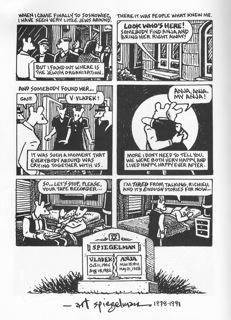
In the (non-HD) excerpt below, there is a striking contrast between the past and present- not only between Vladek's story and Art's point of view, but also with the gravestone. For one, the drawing of his and Anja's gravestone is without a border- showing that it is not confined with Art's story telling; their death is a physical quality with remains and no amount of story twisting is able to dispute that fact. Also, there is no page number on this page, showing that there is no time limit for their death- it is an externalized event. The seemingly ironic mention of Richieu in the last panel demonstrates how the past is continuously haunting Vladeck: he cannot stop thinking about his deceased son even when he is with Art, However, the smoke in the middle of his gravestone (which is strikingly similar to the smoke from the crematorium) shows that not only is his body gone, but his memories that haunted him before also leave him (although they are not gone forever for they are internalized by the story Art has wrote).


Saturday, October 17, 2015

Savoring the last drop of tea

Some things in life never leave us, even when they are long gone physically. Whether it be the best day of your life or the worst, memory is what keeps the past in the back of our minds. Holocaust survivors are unfortunately forever haunted by their inhumane treatment during WWII. In Maus by Art Speigelman, the father is now decades past his Holocaust experience yet he can never escape his memories.

behind bars

With a look at the statistics, the chance of survival was slim, with lack of better words. In certain countries such as Bulgaria, the survival rate was 0%- all fifty thousand people were killed in vain (Holocaust Timeline: Statistics of the Holocaust).  With this in mind, Vladek's ability to survive through the camp was a combination of luck, wit, and intelligence. However, some survivors may believe it would have been better not to survive the camp, as the memories will never leave them (shown in the suicide of Anja). Nevertheless, Vladek is able to continue living despite the inability to move on. It's a bit of a conundrum isn't it? Isn't living a sign of moving through life, through time? Yet Vladeck is shown-more than once- to be weighed down by his memories through his stationary bike and stripes (both panels are shown below).  His memories are like a circle- once they happened, they just kept on playing, never letting him out.  He will also never lose his stripes that decked him in his Holocaust uniform.


when searched on google, Holocaust is classified as a crime. But that seems to whitewash the reality and the after effects.


In a way, the title of this blog post is opposite of its content; although Vladeck will never forget his past (hence the last drop of tea part), it is nowhere near the positive connotation given through the idea of tea.
Disclaimer: sorry about the darker side of this post- some things just cannot be taken lightly.